

business management
How an Internal Business System Can Solve Multiple Problems at Once
A modern internal business system can do much more than manage customers. Learn how connected business software can improve operations, reduce manual work, give owners better visibility, and indirectly support business growth and revenue.
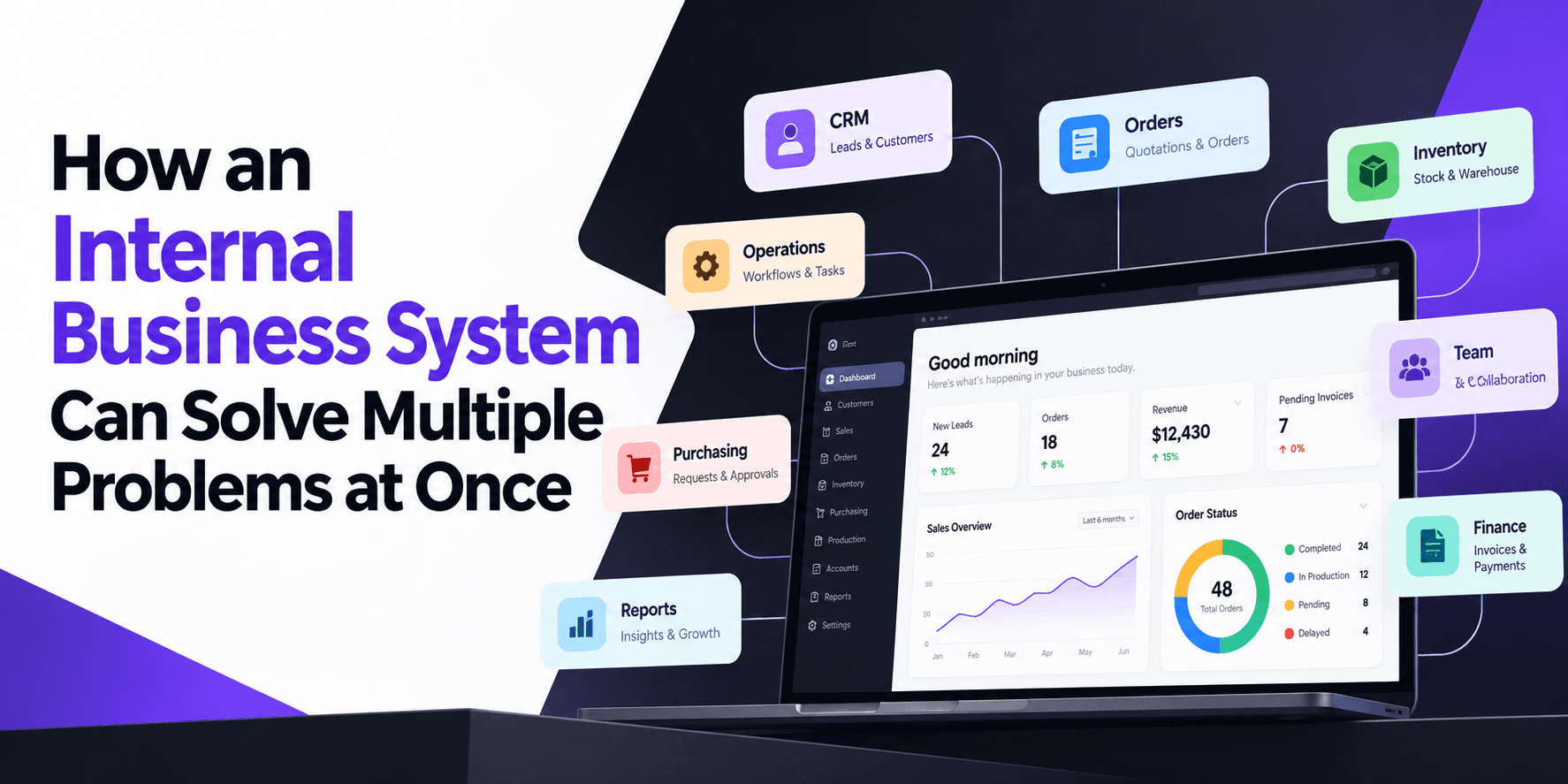
How an Internal Business System Can Solve Multiple Problems at Once
Most businesses do not have just one software problem.
A company might have a CRM for leads, accounting software for invoices, spreadsheets for inventory, WhatsApp for internal communication, email for customer follow-ups, and another tool for managing daily operations.
Individually, these tools may work perfectly well. The problem starts when the business grows and the information between them does not move as smoothly as the business does.
A sales person may know that a customer is waiting for an update, while the operations team does not. The warehouse may know that stock is running low, while the sales team is still promising delivery. An owner may have sales numbers in one system, expenses in another, and operational information in someone's spreadsheet.
This is where an internal business system becomes more useful than simply adding another piece of software.
An internal system is more than a CRM or CMS
When people hear about business software, they often think about familiar categories.
A CRM manages customers and sales. An ERP manages resources and business processes. A CMS manages website content. Accounting software manages financial records.
These systems are useful, but a business does not operate in separate categories.
A new customer can become a quotation, then an order, then a production job, then a delivery, and finally an invoice.
That is one business process.
An internal business system can connect those steps so information does not have to be manually copied from one place to another.
For example, a sales team could create an order once. The operations team can immediately see it. Inventory can be updated based on the order. The production team can see what needs to be completed. The accounts team can see what needs to be invoiced.
The system is no longer just storing information. It is helping the business move work from one stage to the next.
The real problem is often the gaps between departments
Businesses usually do not struggle because they lack enough software.
They struggle because their software, people and processes are disconnected.
Consider a simple example.
A customer asks for a quotation.
The sales person prepares it and sends it by email. The customer approves it. The sales person tells the operations team through WhatsApp. Someone creates a record in a spreadsheet. The warehouse checks stock manually. The accounts team creates an invoice later.
Nothing here is particularly complicated.
But there are several opportunities for information to be missed, duplicated or delayed.
A connected internal system can turn this into a single workflow.
The quotation becomes an order. The order triggers the next operational steps. The right people receive the information they need. Important actions are recorded. Management can see the current status without asking five different people.
That difference becomes increasingly important as a business grows.
It can replace many small manual processes
Not every process needs to be automated completely.
Often, the bigger improvement is simply putting the process in the right place.
An internal system can handle things such as:
- Lead and customer management
- Quotations and orders
- Purchase requests and approvals
- Inventory and warehouse records
- Production or service workflows
- Employee tasks
- Customer communication history
- Invoices and payment status
- Delivery and dispatch tracking
- Internal approvals
- Documents and records
- Reports and dashboards
- Notifications and reminders
The important part is not the number of features.
The important part is how these features work together.
A business might not need a massive ERP with hundreds of modules. It may need a system that handles the 10 or 15 processes that actually matter to its operation.
That is where custom business software can make sense.
Your business does not have to work around the software
Off-the-shelf software is often the right starting point.
There is no reason to build custom software when an existing product already solves the problem well.
But businesses sometimes reach a point where the software starts dictating how work should be done.
You may have to create workarounds because the system does not support a particular approval process. Employees may keep separate spreadsheets because a required report is not available. Someone may maintain a private list because the main system does not store a particular piece of information.
At that point, the problem is not necessarily that the software is bad.
It may simply not match the way the business operates.
A custom internal system can be designed around the actual workflow instead.
That could mean a custom order management system for a manufacturer, a job management platform for a service company, a procurement system for a purchasing team, or a management platform connecting sales, operations and finance.
The goal is not to replace every tool.
The goal is to solve the operational problems that existing tools do not solve properly.
Better visibility changes how owners manage the business
One of the biggest benefits of an internal business system is visibility.
Without a connected system, owners often get information by asking people.
How many new leads came in?
Which orders are delayed?
What is currently in production?
Which customers have not been followed up?
What stock is running low?
Which invoices are overdue?
How much work is currently pending?
These questions may sound simple, but answering them can require checking several systems or asking several employees.
A good internal system puts those answers in one place.
This does not mean the owner needs another complicated dashboard.
Sometimes a few useful numbers are enough.
Current orders. Pending quotations. Outstanding payments. Low-stock items. Open tasks. Delayed jobs. Sales this month.
The value comes from being able to see the business without having to reconstruct what happened from different sources.
This is where software starts supporting growth
An internal system does not create revenue by itself.
It does something more practical.
It removes some of the friction that prevents a business from making more money.
Suppose a company receives 100 leads per month but follows up with only 70 because some enquiries are missed.
Improving the follow-up process can create more opportunities without increasing advertising spend.
Suppose the sales team spends hours every week checking order status with operations.
Giving them direct visibility gives that time back.
Suppose customers regularly call to ask about delivery updates.
Providing a customer or internal tracking system can reduce those interruptions.
Suppose invoices are regularly delayed because the accounts team waits for information from another department.
Connecting the order and invoicing process can reduce that delay.
None of these improvements is a new revenue channel.
But together, they can improve the business's ability to handle more customers with the same team.
That is one of the less obvious ways business software supports growth.
Growth is not only about getting more customers
There is a common assumption that growth means generating more leads and making more sales.
That is only one part of it.
If a business doubles its sales but its internal processes cannot handle the additional work, growth can create new problems.
Orders take longer.
Employees spend more time coordinating.
Errors increase.
Customers receive slower responses.
Management loses visibility.
The business needs more people just to keep up with administrative work.
A connected internal system can help create operational capacity before the business reaches that point.
If the same team can handle more orders because less time is spent searching for information, updating spreadsheets and coordinating manually, the company has effectively increased its capacity.
That can have a direct financial impact.
It can also protect revenue that already exists
Growth is not only about winning new customers.
Businesses also lose money through operational problems.
A missed follow-up can mean a lost sale.
A delayed quotation can mean a customer chooses another supplier.
Incorrect inventory information can lead to cancelled orders.
A missed renewal can mean lost recurring revenue.
An invoice that is not sent on time delays payment.
A customer who repeatedly has to ask for updates may eventually move to another provider.
An internal system can make these processes more visible and consistent.
It does not guarantee that these problems disappear. But it can make them much harder to overlook.
The system should follow the business process
The mistake is to start with a list of software features.
Instead of asking, “What modules should we build?”, start with questions such as:
How does a customer move from enquiry to payment?
Where does information get entered?
Where is it copied manually?
Where do approvals happen?
Where do delays happen?
Which tasks depend on one particular employee remembering to do something?
Which information does management regularly ask for?
Which reports take too long to prepare?
Where do customers experience unnecessary delays?
These questions reveal where a system can actually help.
The final software might contain a CRM, inventory management, order management, reporting and workflow automation.
But those are components.
The real product is the business process that connects them.
You do not need to replace everything
A common concern with internal business systems is that implementing one means replacing the company's existing software.
That is not necessarily true.
A business may already have excellent accounting software, a payment provider, email platform, ecommerce website or payroll system.
The internal system can sit between those tools and connect the parts that need to work together.
For example, the system might manage customers, quotations, orders and operations while sending financial information to the existing accounting software.
This approach can be much more practical than attempting to replace every system at once.
The objective is not to create one giant application simply because having everything in one place sounds attractive.
The objective is to create a reliable flow of information between the systems and people that run the business.
When does a business need an internal system?
There is no specific employee count at which every company suddenly needs custom software.
The better indicator is operational complexity.
You may be reaching that point when several people need the same information but maintain separate versions of it.
Or when employees regularly ask each other for status updates.
Or when spreadsheets have become important enough that losing one would create a serious problem.
Or when management spends too much time collecting information instead of using it.
Or when adding more customers requires adding more administrative work at almost the same rate.
Or when existing CRM, ERP or business software handles individual departments well but does not connect the complete workflow.
These are signs that the business may have outgrown its current way of managing information.
The goal is a business that is easier to run
The best internal systems are often not the most complicated ones.
They are the ones that make everyday work easier.
A salesperson should not need to understand how the warehouse works to see whether an order is ready.
A warehouse employee should not need to search through emails to know what needs to be shipped.
An owner should not need to ask three employees for a basic business number.
An accounts team should not have to wait for someone to send information that already exists somewhere else.
When information flows naturally through the business, people can spend more time doing their actual work.
That is ultimately what an internal business system should achieve.
It should give the business better control over its operations, make information easier to access, reduce unnecessary manual work and create a stronger foundation for growth.
It may contain a CRM.
It may contain ERP functions.
It may connect to a CMS, accounting platform, ecommerce website or other tools.
But it does not have to be defined by any one of them.
A well-designed internal business system is built around the business itself.
And when the business runs better, growth becomes easier to handle.
Frequently asked questions
Quick answers to common questions about this topic.
Related articles
Continue exploring systems, architecture, and automation topics.