



ComparisonCRM
HubSpot vs Custom CRM: Which Actually Fits Your Sales Team?
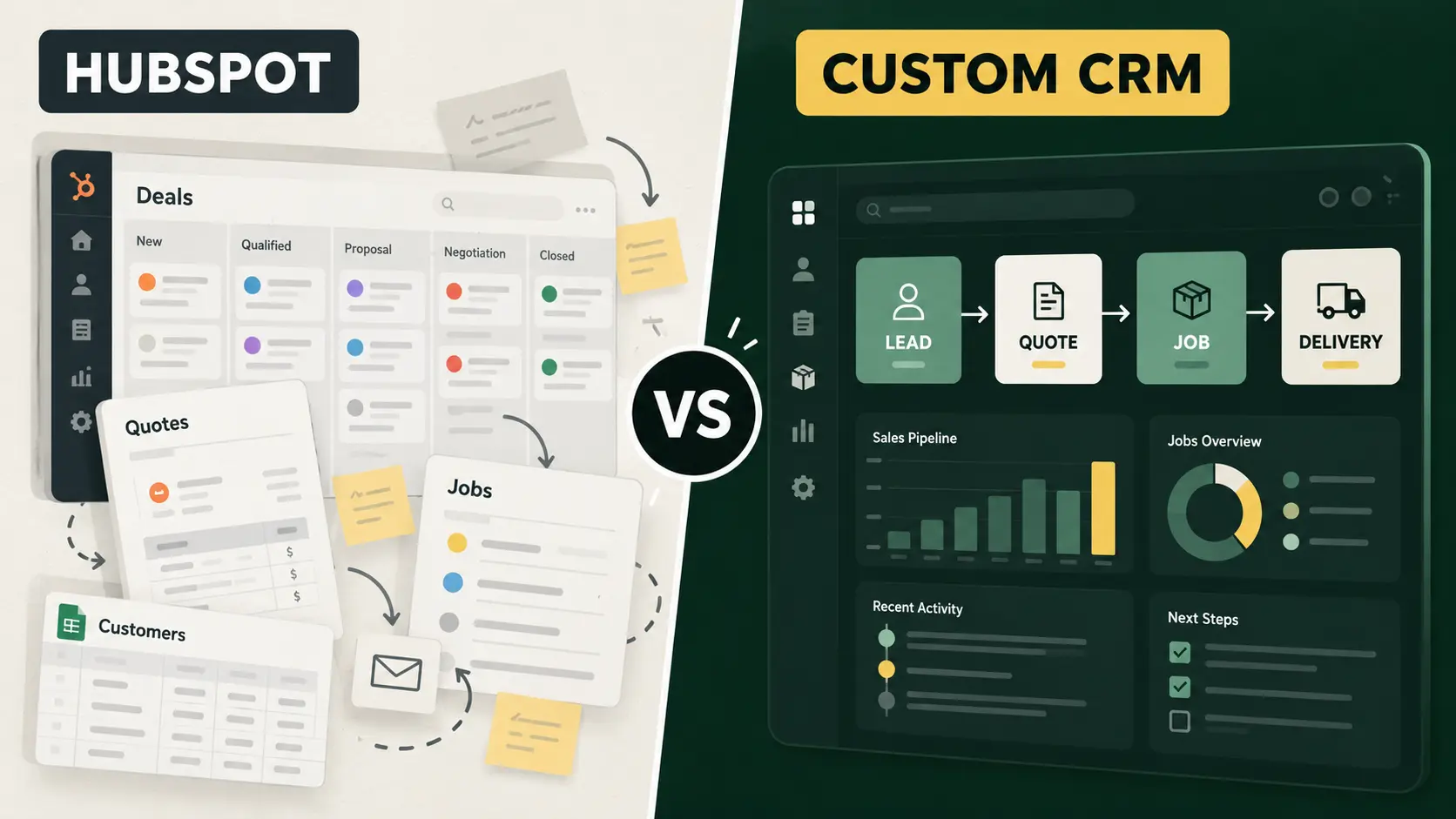
HubSpot is built for a standard sales pipeline. If your deals depend on quotes, approvals, bookings, commissions, or operational handoffs, compare what it takes to make HubSpot fit versus owning a CRM built around your process.

Get a Quote
Already know which one you need?
Get a tailored quote within 12-24 hrs.




Trusted by 50+ businesses as their technical partner
100+
Projects delivered
10+
Industries served
8+
Years in business
HubSpot vs Custom CRM: Which Actually Fits Your Sales Team? — 8 decision criteria
Hover a column to isolate one option. Highlighted rows are where each option wins — the full reasoning behind every judgment is below.
| What matters | HubSpot Off-the-shelf SaaS | Custom CRM by XupyterOurs Built around your workflow |
|---|---|---|
| Sales pipeline fit | Your team adapts to HubSpot’s objects and stages; anything unusual becomes a workaround | Stages, fields, and rules designed around the way your team actually sells Best choice |
| Quotations and job bookings | Quoting is limited and job bookings usually need another tool or a custom integration | Quotes, approvals, bookings, and job records connected in one workflow Best choice |
| Sales-to-operations handoff | Every handoff is a manual copy, an email, or a fragile integration | The handoff is built into the system, so nobody re-enters the same deal Best choice |
| Business-specific rules | Pricing, commissions, and approval logic are constrained by plan features | Your pricing, approval, commission, and exception rules are encoded directly Best choice |
| Operational reporting | Reports only cover what the CRM knows; the rest lives in spreadsheets | One reporting source from first enquiry through delivery and aftercare Best choice |
| Data ownership | Your pipeline data lives inside a vendor platform on the vendor’s terms | You own the application, the data model, and the customer records Best choice |
| Cost structure | Per-seat, per-tier subscriptions that rise as the team and contact list grow | One build investment, then predictable hosting and maintenance — no per-seat tax Best choice |
| Time to value | Fast on a standard pipeline, slow and expensive to reshape once the business outgrows it | Designed around your process from day one, so adoption holds as you grow Best choice |
HubSpot
Your team adapts to HubSpot’s objects and stages; anything unusual becomes a workaround
Custom CRM by Xupyter· ours
Stages, fields, and rules designed around the way your team actually sells
HubSpot
Quoting is limited and job bookings usually need another tool or a custom integration
Custom CRM by Xupyter· ours
Quotes, approvals, bookings, and job records connected in one workflow
HubSpot
Every handoff is a manual copy, an email, or a fragile integration
Custom CRM by Xupyter· ours
The handoff is built into the system, so nobody re-enters the same deal
HubSpot
Pricing, commissions, and approval logic are constrained by plan features
Custom CRM by Xupyter· ours
Your pricing, approval, commission, and exception rules are encoded directly
HubSpot
Reports only cover what the CRM knows; the rest lives in spreadsheets
Custom CRM by Xupyter· ours
One reporting source from first enquiry through delivery and aftercare
HubSpot
Your pipeline data lives inside a vendor platform on the vendor’s terms
Custom CRM by Xupyter· ours
You own the application, the data model, and the customer records
HubSpot
Per-seat, per-tier subscriptions that rise as the team and contact list grow
Custom CRM by Xupyter· ours
One build investment, then predictable hosting and maintenance — no per-seat tax
HubSpot
Fast on a standard pipeline, slow and expensive to reshape once the business outgrows it
Custom CRM by Xupyter· ours
Designed around your process from day one, so adoption holds as you grow

Verdict
HubSpot fits a standard pipeline. Build when your pipeline is the advantage.
Use HubSpot if your sales process is genuinely generic and you only need standard deal tracking. The moment quotes, approvals, bookings, commissions, or operational handoffs decide whether you win the deal, subscription software stops being the cheaper option. A custom CRM removes the seat tax, the integration glue, and the workarounds — and gives you a system that gets better as your business does.
Trusted by 50+ businesses as their technical partner
The real question is not HubSpot versus custom
It is whether your sales process fits inside a standard CRM. HubSpot is polished software for companies that sell through a familiar pipeline: lead, contact, deal, follow-up, close. If that is genuinely your business, it can work.
But most custom software conversations start with a sentence like this: “The CRM tracks the deal, then we do the actual work somewhere else.” A quote is built in a spreadsheet. A discount is approved over email. A booking is confirmed in another system. Someone retypes the same customer details three times. That is not a CRM problem. It is a workflow problem, and no subscription plan fixes it cleanly.
Where HubSpot starts to cost you
- Every seat, contact tier, and automation upgrade adds another recurring line to the invoice.
- Operational steps that do not exist in HubSpot become plugins, integrations, or manual admin.
- Reports stop at the CRM boundary, so managers still stitch numbers together by hand.
- Your process has to bend around the platform’s roadmap, not the other way around.
None of those costs show up as a single obvious fee. They appear as slower quote turnaround, duplicated data entry, missed handoffs, and a team that quietly works around the tool instead of through it.
What a custom CRM changes
A custom CRM starts with how your business wins deals, then builds the system around it. That means the records, permissions, pricing rules, approvals, and handoffs are designed for your operation from the start.
- A quote follows your company’s pricing and approval rules automatically.
- An accepted quote creates the job, booking, or operational task without re-keying.
- Every lead has a clear owner, next action, and escalation path.
- Managers see one live view from first enquiry through delivery.
The cost comparison most buyers get wrong
HubSpot looks cheaper in month one. The honest comparison is over three to five years, including subscriptions, add-ons, implementation, integrations, internal admin, and the revenue lost when handoffs slip.
A custom CRM front-loads the investment, then replaces per-seat licensing with hosting, maintenance, and support. For a growing team, that usually means the cost curve flattens while the value curve keeps rising. You also stop paying to rent a system that does not quite fit.
Why growing sales teams choose custom
The businesses that get the most from custom CRM are not trying to rebuild every standard feature. They are protecting the part of their process that customers pay for: the way they qualify, quote, approve, book, and deliver.
If that process is your edge, renting a generic pipeline is a permanent tax on your advantage. Owning the system turns it into an asset.
Start with your workflow, not a feature list
At Xupyter Solutions, we map what happens from the first enquiry to delivery and identify exactly where HubSpot is helping, where it is being worked around, and where a custom system would pay for itself. If standard software is genuinely enough, we will tell you. If it is not, we will show you what owning the right CRM looks like.
Frequently asked questions
Quick answers to common questions about this topic.