


ComparisonCustom Software
Custom Software vs Off-the-Shelf: Build or Buy for Your Business?
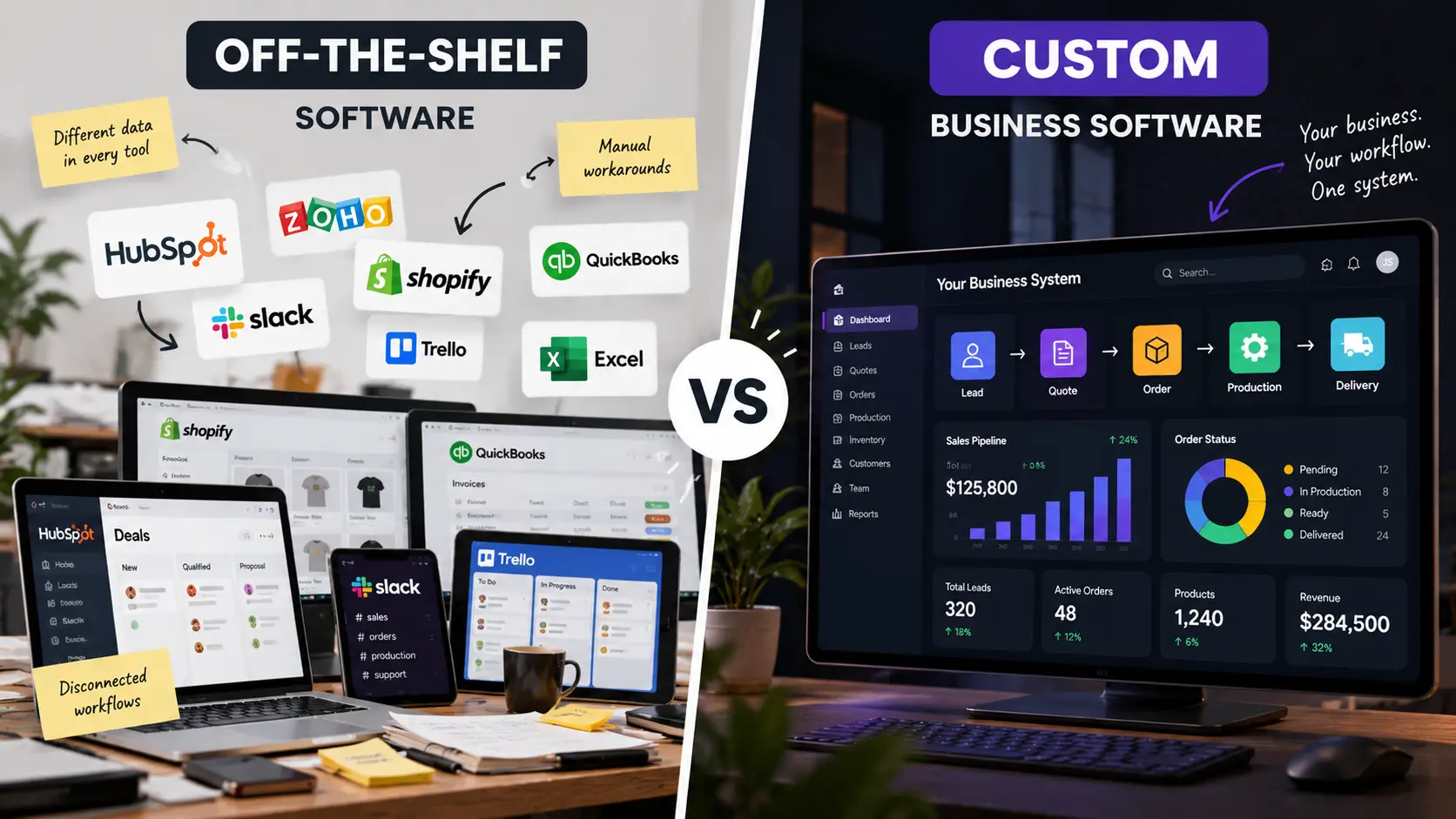
Off-the-shelf software is faster to adopt and often cheaper to start. Custom software wins when important processes do not fit, systems must work together, or the workarounds carry a real operating cost. Here is how to decide without guessing.

Get a Quote
Already know which one you need?
Get a tailored quote within 12-24 hrs.




Trusted by 50+ businesses as their technical partner
100+
Projects delivered
10+
Industries served
8+
Years in business
Custom Software vs Off-the-Shelf: Build or Buy for Your Business? — 9 decision criteria
Hover a column to isolate one option. Highlighted rows are where each option wins — the full reasoning behind every judgment is below.
| What matters | Off-the-Shelf Software Subscription products | Custom Software by XupyterOurs Built around your operation |
|---|---|---|
| Time to start | Fast to buy, slow to fit; implementation and workarounds drag on after go-live | Focused discovery then a purposeful build — no dead features or unused modules Best choice |
| Upfront investment | Low entry price, but subscriptions, add-ons, integrations, and seats keep charging | Higher upfront investment, then predictable ownership and no per-seat licensing Best choice |
| Workflow fit | You change your process to match the product’s assumptions | The system is designed around the process that makes your business different Best choice |
| Integrations | Connector availability, APIs, and plan limits decide what is possible | Integrations scoped to the systems you actually use, with clear ownership Best choice |
| Product changes | The vendor roadmap controls what you get and when you get it | You decide what changes, when, and in what order Best choice |
| Maintenance | The vendor maintains the core; you still maintain configuration and workarounds | One accountable partner for the system, its support, and its evolution Best choice |
| Long-term cost | Subscriptions compound while workarounds quietly add labour and lost time | No recurring seat tax; the build cost amortises as the system earns Best choice |
| Competitive edge | Your competitors can buy the same software and run the same process | Software that encodes how you win and is not available to competitors Best choice |
| Best fit | Commodity needs where a standard product genuinely fits | Distinctive, interconnected workflows that drive revenue or margin Best choice |
Off-the-Shelf Software
Fast to buy, slow to fit; implementation and workarounds drag on after go-live
Custom Software by Xupyter· ours
Focused discovery then a purposeful build — no dead features or unused modules
Off-the-Shelf Software
Low entry price, but subscriptions, add-ons, integrations, and seats keep charging
Custom Software by Xupyter· ours
Higher upfront investment, then predictable ownership and no per-seat licensing
Off-the-Shelf Software
You change your process to match the product’s assumptions
Custom Software by Xupyter· ours
The system is designed around the process that makes your business different
Off-the-Shelf Software
Connector availability, APIs, and plan limits decide what is possible
Custom Software by Xupyter· ours
Integrations scoped to the systems you actually use, with clear ownership
Off-the-Shelf Software
The vendor roadmap controls what you get and when you get it
Custom Software by Xupyter· ours
You decide what changes, when, and in what order
Off-the-Shelf Software
The vendor maintains the core; you still maintain configuration and workarounds
Custom Software by Xupyter· ours
One accountable partner for the system, its support, and its evolution
Off-the-Shelf Software
Subscriptions compound while workarounds quietly add labour and lost time
Custom Software by Xupyter· ours
No recurring seat tax; the build cost amortises as the system earns
Off-the-Shelf Software
Your competitors can buy the same software and run the same process
Custom Software by Xupyter· ours
Software that encodes how you win and is not available to competitors
Off-the-Shelf Software
Commodity needs where a standard product genuinely fits
Custom Software by Xupyter· ours
Distinctive, interconnected workflows that drive revenue or margin

Verdict
Buy what is standard. Build what makes your business different.
Off-the-shelf software is the right call for commodity needs where a product genuinely fits. Custom software is the right call when your process is the advantage, when several systems need to behave as one, or when workarounds are already costing more than a build. The mistake is buying a generic tool for a distinctive process and paying for the mismatch every month.
Trusted by 50+ businesses as their technical partner
The build-versus-buy decision is really about fit
Buying software is usually the fastest way to solve a familiar problem. Accounting, email, document collaboration, and standard CRM functions are good examples of needs that rarely justify a custom build.
Custom development takes longer and requires a real investment. The case for it starts when a business has an important process that existing products do not support comfortably — or when several tools cover individual tasks but leave employees coordinating the gaps.
Where off-the-shelf starts to cost more than it saves
- Subscriptions and per-seat fees keep rising as the team grows.
- Add-ons and integrations are needed just to make the product fit.
- Employees copy data between tools because the workflow crosses systems.
- The vendor roadmap decides when a critical requirement gets attention.
- The same software is available to every competitor, so it cannot encode an advantage.
The cost is not only the software bill. It is the time spent maintaining the connections between tools and the operational consequences when information is late or incomplete.
What custom software changes
Custom software lets the business define the workflow, records, permissions, and rules around its actual requirements. It can replace a cluster of disconnected steps, or connect existing tools through a focused application.
- One system that reflects how work really moves through the business.
- Integrations designed around the systems you keep, not a vendor’s connector list.
- No per-seat licensing as the team grows.
- Changes planned around business priorities rather than a public roadmap.
- A system that encodes your operating advantage instead of erasing it.
The cost comparison that matters
Off-the-shelf software often has a lower initial cost, but recurring subscriptions, additional seats, premium features, integrations, and implementation add up. Custom software requires a larger initial investment and ongoing hosting, maintenance, support, security, and future changes.
Compare both over the same period. Include software fees, setup, integration, internal administration, manual work, training, migration, and maintenance. Then ask the harder question: which option makes the business faster, more reliable, and harder to copy?
You do not have to replace everything
This does not have to be a choice between replacing every tool and doing nothing. If accounting software works well, keep it. If a CRM is effective for a standard function, keep it. A custom operational layer can connect the tools and manage the specific workflow they do not cover.
That approach reduces disruption and avoids rebuilding commodity capabilities. It still requires careful decisions about data ownership, integration reliability, and support.
Build the smallest system that removes the constraint
The first step is not to commission a large build. It is to map the workflow, identify the costly gaps, and decide whether configuration, integration, or custom development is the best response.
Xupyter Solutions works with startups and SMEs on internal systems, CRM, inventory, order management, and workflow automation. We build only what the business needs, integrate the tools that still earn their place, and give you an owned system that compounds in value instead of a subscription that compounds in cost.
Frequently asked questions
Quick answers to common questions about this topic.